

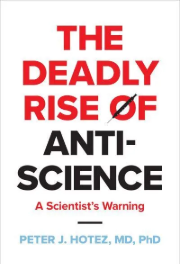
The Deadly Rise of Anti-Science
5th December 2025
Peter J Hotez
Johns Hopkins University Press, £14.99
Why is vaccine uptake falling and what can be done to improve vaccine coverage? The book’s author, Peter Hotez, is a high-profile American paediatrician, vaccine advocate and public health expert attempting to answer these questions. The Deadly Rise of Anti-Science begins by discussing anti-vaccine activism, which, in Hotez’s account, is spreading into a broader anti-science movement. Hotez details the significant gains made over the last 100 years in public health, particularly through the use of vaccines, and how much of that work is being undone by political and cultural forces.
With a focus on the US, Hotez describes the aggression that many scientists experience, not just online, but also, sadly, through physical confrontations. The book describes how an open contempt for science became normalised during the COVID-19 pandemic to the extent that an estimated 200,000 lives in the US may have been lost due to vaccine hesitancy.
Hotez identifies two reasons for the decline in vaccine uptake: first, misinformation itself; and, second, the financial and political support for such misinformation.
While anti-vaccine attitudes are not new, Hotez worries that the contemporary movement is not just anti-vaccine, but anti-science. This is cloaked in the language of ‘health freedom’ or ‘medical freedom’. Objections to Government intervention, and advocacy for unevidenced therapies and cures, form part of this anti-science response.
The consequences of this are concerning, with outbreaks of polio and measles, as well as preventable COVID-19-related deaths. Hotez identifies three prongs to this propaganda: one is against Government interference generally, another objects to alleged state or Federal Government alliance with ‘Big Pharma’, and the third is pseudoscience about ‘natural immunity’. Additionally, informed consent, which is essential to ethical access to medical services and research, is weaponised against science. A considerable amount of misinformation, particularly online via social media, is boosted and supported financially by the political right, according to Hotez. Such was the extent of the politicisation of COVID-19 and its vaccines that Democrat-leaning states consistently had lower COVID-19-related deaths than Republican-leaning ones.
This anti-science movement has gone global, with anti-mask and anti-vaccine rallies and misinformation seen across Europe and Africa. Hotez’s experience suggests that while it is vital to put out adequate, timely and digestible scientific information, and actively engage in public outreach and understanding activities, this must be coupled with efforts to tackle anti-science arguments head on.
These efforts need to be built on an understanding of human psychology, where appeals to emotion and core human values must accompany the bare facts. Science, and the science of public engagement, must develop if we are to persuade the growing number of sceptics in the world.
Conor McCrory MRSB