

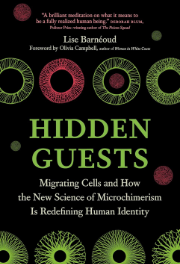
Hidden Guests: Migrating Cells and How the New Science of Microchimerism Is Redefining Human Identity
5th December 2025
Lise Barnéoud
Greystone Books £18.99
Much of our biological and cultural identity stems from the idea that our bodies (and lives) stem from just one fertilised egg and a mix of our parents’ DNA. The remarkable Hidden Guests, by science journalist Lise Barnéoud, throws a grenade into this idea, showing how many people, in fact, have large populations of cells growing in their body with entirely different genetic origins. This most commonly occurs when the cells of one sibling are transferred to or absorbed by another in the womb, when cells of parents and offspring are exchanged during pregnancy, or when the cells of complete strangers take root following organ donations or blood transfusions.
The growing body of research on this topic not only challenges the idea of what an individual is, but has profound consequences for genetic fingerprinting and genetic medicine. Barnéoud highlights numerous fascinating cases, such as the woman whose children were nearly taken away after genetic testing ‘proved’ she was not their mother until she was able to establish that their DNA came from her vanished twin, whose cells she had absorbed in utero.
Other cases are just as unsettling, such as the man whose DNA was matched to a crime scene he couldn’t possibly have ever been at. The DNA was actually not ‘his’ at all, but that of his bone-marrow donor – who turned out to be the actual perpetrator of the crime.
Even more worrying is the number of forensic or genetic tests that have reached misleading conclusions due to microchimerism – errors that may never come to light due to the highly specialist knowledge required to recognise them.
There are plenty of biological questions to explore too. How and why can a ‘foreign’ cell embed itself into another person’s tissue so harmoniously without being rejected or identified as different? What does it mean for the idea of an ‘individual’ of a species and how widespread might chimerism be in life in general? Barnéoud talks to researchers and medical experts at the forefront of microchimerism research in an attempt to understand these and other immunological, developmental, genetic and philosophical head-scratchers.
It has long been known that virtually all the cells in your body will be replaced every decade or so, that there are probably more bacterial cells in our bodies than human cells, and that the genetic instructions in our cells can and do change over the course of our lives. Now, fascinating insights from microchimerism research only add to the idea that each human body is an ever-shifting community of genes and cells, perhaps more akin to a functional ecosystem than a solid and permanent physical structure.
Tom Ireland MRSB